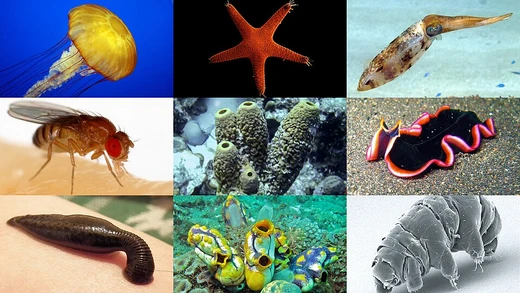
Kinorhyncha
Small marine invertebrates known as mud dragons.

Kinorhyncha, commonly called mud dragons, is a phylum of small marine invertebrates found in mud or sand at all depths as part of the meiobenthos. Modern species are 1 mm or less, but Cambrian forms could reach 4 cm. They are limbless animals with a segmented body consisting of a head, neck, and trunk of eleven segments, and are the only members of Ecdysozoa, except panarthropods, with a segmented body.
- common_name
- Mud dragons
- size
- Modern species 1 mm or less; Cambrian forms up to 4 cm
- habitat
- Marine mud or sand at all depths
- phylum
- Kinorhyncha
- closest_relatives
- Loricifera and Priapulida (Scalidophora)
- oldest_known_species
- Eokinorhynchus from the Fortunian of China
Lore & Background
Kinorhynchs are limbless animals with a body divided into head, neck, and eleven trunk segments. Juveniles have eight or nine segments, with the last two or three added during growth. A Cambrian species, Eokinorhynchus rarus, had about twice as many segments as present forms. They have no external cilia but possess spines along the body and up to seven circles of spines around the head, used for locomotion by withdrawing the head and pushing forward, then gripping the substrate. The body wall secretes a tough cuticle that is molted several times during growth. The head is completely retractable and covered by neck plates called placids when retracted.
Reader's Guide
Kinorhyncha are significant as a phylum of meiobenthic invertebrates that contribute to the understanding of ecdysozoan evolution and segmentation. Their segmented body, unique among ecdysozoans except panarthropods, likely evolved independently. The oldest known species, Eokinorhynchus from the Fortunian of China, provides insight into early Cambrian forms. Their closest relatives are Loricifera and Priapulida, together forming the Scalidophora. Kinorhynchs lack a circulatory system but have a well-developed pseudocoelom and excretory system of two protonephridia. They feed on diatoms or organic material, and reproduction involves two sexes with free-living larvae, though details remain largely unknown.
Did You Know?
- Modern kinorhynchs are 1 mm or less, but Cambrian forms could reach 4 cm.
- They are the only members of Ecdysozoa, except panarthropods, with a segmented body.
- Individual spermatozoa can reach a quarter of the total body length.
- The oldest known species is Eokinorhynchus from the Fortunian of China.
More in Other Invertebrates 1-22
Spotted an error? Know more?
This is a living reference — every entry is fact-audited, and reader corrections feed straight into our audit queue. Suggest an edit · See this site's audit record